


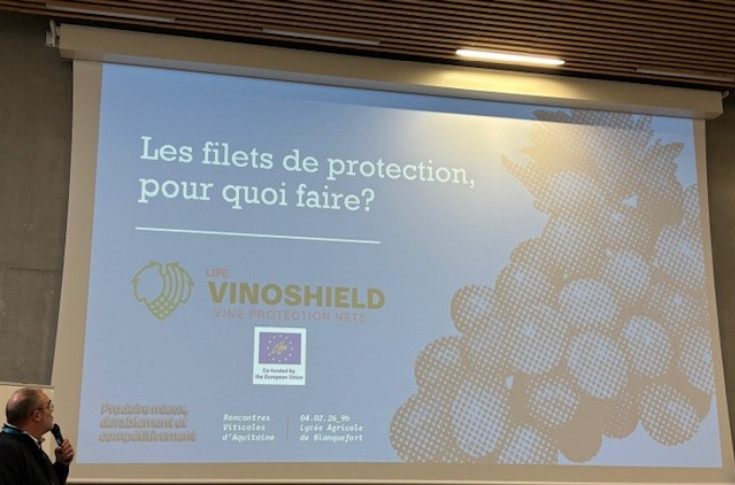
Presentation at Rencontres Viticoles d’Aquitaine 2026
Blanquefort, France | February 4, 2026
The LIFE VINOSHIELD project continues to share its technical progress with industry professionals. During the “Rencontres Viticoles d’Aquitaine” held in Blanquefort, Marc Vergnes, viticulture technician at the Institut Français de la Vigne et du Vin (IFV) – Vinopôle Bordeaux Aquitaine, delivered a comprehensive presentation on using protective nets as a lever for resilience against climate hazards.
A new tool for the wine industry
In the face of increasing spring frosts, hail, and sunburn (scalding), protective nets are no longer just niche tools. The presentation highlighted that these passive technologies protect the vines throughout high-risk periods without requiring fossil fuels or chemical inputs.
Field feedback: Key lessons from 2025 trials in the Bordeaux region
Marc Vergnes shared concrete results from the project’s experimental sites. Three types of nets were tested (anti-hail/shading, and the “plasticized” Rain’net © for frost and rain) with several notable observations:
- Thermal protection: Effectiveness on grape cluster surface temperature is significantly higher with full-mesh nets, which limit the risk of sunburn during heatwaves.
- Vine physiology: Optical measurements taken on leaves revealed higher chlorophyll and nitrogen content under the nets, indicating preserved physiological function.
- Physical barrier: Beyond climate protection, the nets proved to be an excellent defense against damage caused by deer and local wildlif.
The importance of a tailored approach
The key message of this conference, also covered by the specialized press (see the Vitisphere article), is that simply installing a net is not enough: the specific needs of each plot must be precisely evaluated.
Integrating nets requires a global reflection on:
- Trellising architecture: Adapting catch wires and the overall structure to support the weight and tension of the nets.
- Ergonomics: Equipment choice must account for ease of handling for the grower.
- Management: Net deployment must be reasoned based on weather forecasts and does not replace rigorous management of soil water reserve.
Next steps for LIFE VINOSHIELD
These observations will be continued through 2026 to consolidate long-term data. The consortium is specifically working on comparing total vine coverage versus partial coverage to further optimize protection against both sanitary and climatic risks.